Home / Guides / Reading a determination
How to read a California prevailing wage determination
California's Department of Industrial Relations (DIR) publishes prevailing wage rates as determinations, one per craft, issued on February 22 and August 22 each year. One line of a determination holds the wage, five kinds of employer payments, overtime rates and a set of footnote letters, and the letters can change what the numbers mean. The examples below are DIR's real August 2026 files: the Northern California carpenter PDF and the Alameda County table.
Written from DIR's 2026-2 determinations (issued August 22, 2026) and DIR's prevailing wage FAQ. Published October 24, 2026. The determination named in your bid documents controls.
Two formats: regional PDFs and county tables
DIR's 2026-2 determinations menu has you check them in a fixed order.
The big crafts (carpenter, laborer, operating engineer and others) come as one PDF per craft covering a group of counties, filed under Statewide, Northern California, Southern California or San Diego. There are more than a hundred of these. If your craft isn't in one of them, the menu sends you to the county determinations, which DIR calls "subtrades": one HTML table per county listing the remaining crafts. The menu's last step is the important notices page, where DIR posts corrections and modifications that may apply to a determination.
So a carpenter in Fresno County is in a Northern California PDF, and an inside wireman in Alameda County is in the Alameda County table. Our pages show which file each rate came from, for example carpenter rates in Fresno County and electrician rates in Alameda County.
Reading a regional PDF
The first page of the carpenter determination, with the parts numbered.
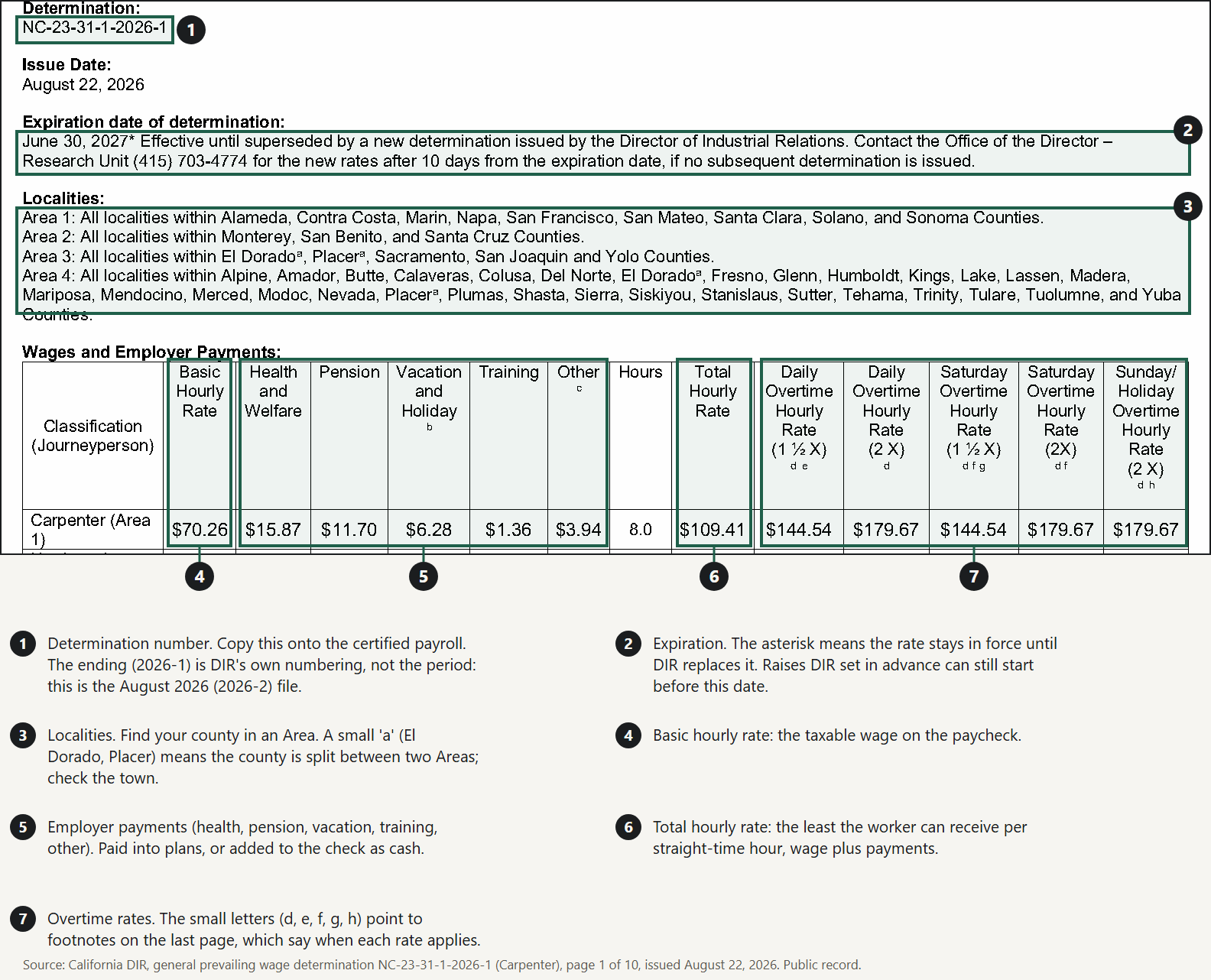
Determination number (1). This is the ID you quote when you refer to the rate. The ending is DIR's own numbering and doesn't tell you the period: this carpenter file ends in 2026-1 but it is in DIR's 2026-2 set, issued August 22, 2026. The page headers on pages 2 to 10 print the same number as NC-023-31-1-2026-1, with an extra zero.
Issue date and expiration (2). DIR's FAQ defines the issue date (Q5) as the date copies of the determination are deposited in the mail. The expiration date and the asterisk after it are covered below.
Localities (3). Find your county in one of the Areas, then read only the rows marked with that Area. Fresno is in Area 4, so a Fresno carpenter's line is "Carpenter (Area 4)" on page 2: $63.03 base, $102.18 total. A small "a" after a county name means it is split. Footnote a in this file says Area 3 covers the parts of Placer and El Dorado counties west of and including Highway 49, plus the city of Placerville, and Area 4 covers the rest of both counties. For a job in Auburn or Placerville you need the project's location, not just the county.
Area numbers belong to one determination. Fresno is Area 4 for carpenters but Area 2 in the laborer determination, which draws its own map. The statewide picture for one trade is on our carpenter page.
The columns
Carpenter (Area 1), straight shift, from page 1 of NC-23-31-1-2026-1. The county tables use the same columns in a different order.
| Column | Area 1 | What it is |
|---|---|---|
| Basic hourly rate | $70.26 | The wage per straight-time hour, before employer payments. |
| Health and welfare | $15.87 | Employer payments per hour worked. Small letters under a heading (b, c here) point to footnotes saying what is inside. In this file, footnote c lists six items under "Other", including the annuity trust fund and industry promotion. |
| Pension | $11.70 | |
| Vacation and holiday (b) | $6.28 | |
| Training | $1.36 | |
| Other (c) | $3.94 | |
| Hours | 8.0 | Hours in the straight-time day. The 2nd and 3rd shift tables later in the file show 7.5 and 7.0. |
| Total hourly rate | $109.41 | Base plus the five payments: 70.26 + 15.87 + 11.70 + 6.28 + 1.36 + 3.94. |
| Daily overtime (1½×) | $144.54 | Overtime rates, already worked out. Here the base is multiplied and the payments are added flat: 70.26 × 1.5 + 39.15 = $144.54. Some footnotes say a payment is "factored at the applicable overtime multiplier", and then it is multiplied too. |
| Daily overtime (2×) | $179.67 | |
| Saturday overtime (1½×) | $144.54 | |
| Saturday overtime (2×) | $179.67 | |
| Sunday/holiday overtime (2×) | $179.67 |
The base rate isn't fixed on its own. Several Alameda footnotes (Q, AP, AQ and others) cite Labor Code sections 1773.1 and 1773.8 and say the amount paid for an employer payment "may vary resulting in a lower taxable basic hourly wage rate, but the total hourly rates for straight time and overtime may not be less than the general prevailing rate." Check the total first, then how it is split.
Reading a county table
Alameda County, determination ALA-2026-2, as DIR publishes it.
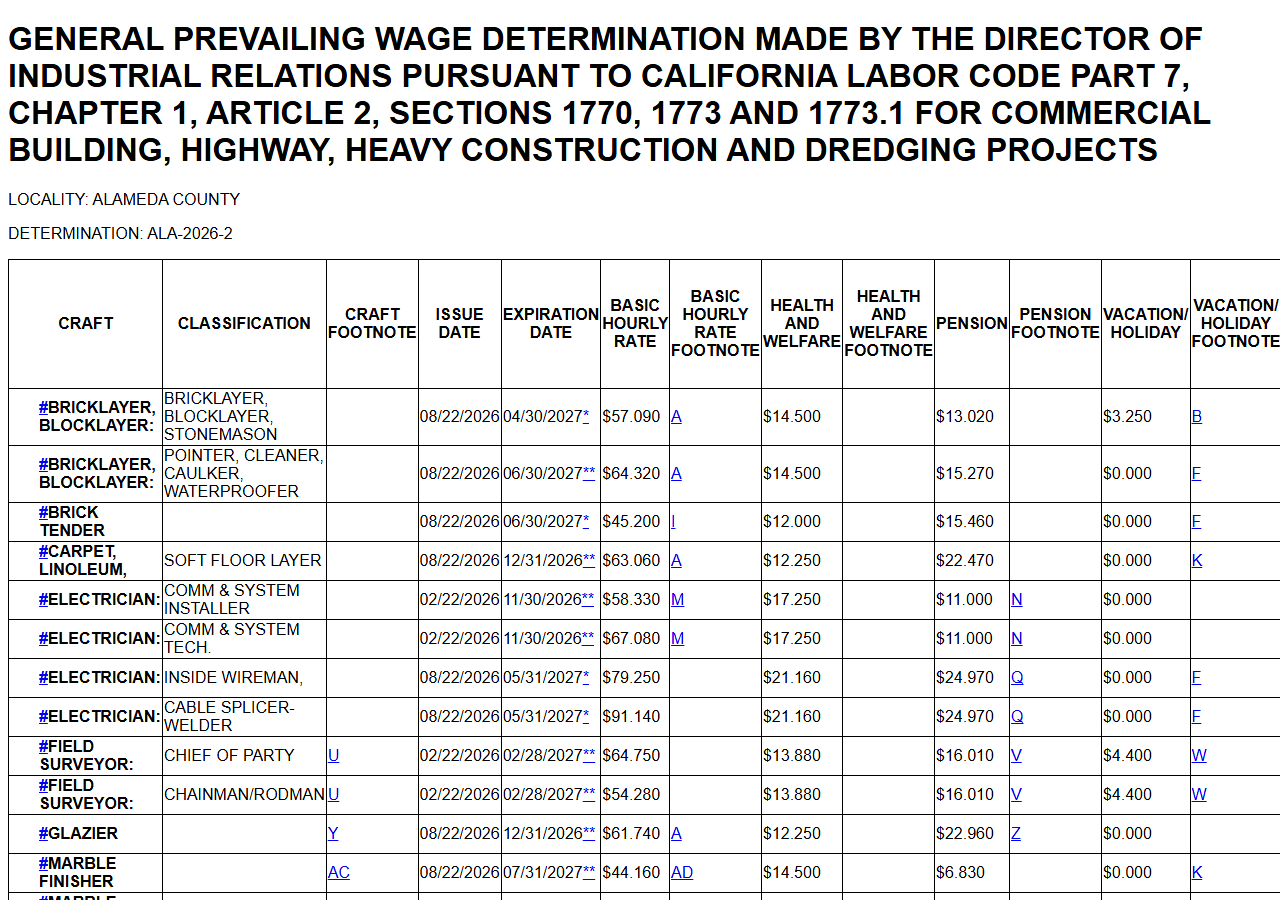
Each row is one classification, and each row carries its own issue and expiration dates. They don't all match: in ALA-2026-2 the two communications electrician rows still show an issue date of 02/22/2026, while Inside Wireman shows 08/22/2026. Money is printed to three decimals ($79.250). Most columns have a footnote column beside them, and the letters link to a list at the bottom of the page, which runs from A to BH in this file. The table is 29 columns wide, so on a phone you scroll sideways to reach the total and overtime rates.
For Inside Wireman the columns read $79.25 base, $21.16 health and welfare, $24.97 pension (footnote Q), $0 vacation/holiday (footnote F, "included in straight-time hourly rate"), $2.43 training and $1.48 other (footnote R), with a total of $131.67. Those six figures add up to $129.29. Footnote Q covers the gap: "an amount equal to 3% of the basic hourly rate is added to the total hourly rate and overtime hourly rates for the National Employees Benefit Board." Three percent of $79.25 is $2.38, and $129.29 + $2.38 = $131.67. Our Alameda electrician page shows the same row with DIR's footnotes written out.
Footnote letters
The letters are defined separately in each file: "F" in the Alameda table and "f" in the carpenter PDF mean different things.
Most footnotes fall into a few kinds. Some add money to the total, like Q above, or N and O in the Alameda table (3% and 0.5% of the base). Some say what a payment includes: carpenter footnote b says the vacation and holiday column "includes an amount per hour worked for Work Fees and Vacation." Some say a column is folded into another one, like Alameda's F ("included in straight-time hourly rate") and K ("included in basic hourly rate").
The ones that cost money if they're missed are the overtime hour rules, because they decide which column applies to which hour. In the carpenter file:
- e: for building construction, the 1½× daily rate "applies to the first 4 hours daily overtime." After that it's the 2× column.
- g: the 1½× Saturday rate applies to "the first 8 hours for building construction and for the first 10 hours worked on heavy, highway and engineering construction."
- f: if weather or a major breakdown stops work Monday to Friday, employees "may voluntarily make up such day on Saturday" at straight time.
- h: time and a half for the first eight hours on four days a year that the union designates as off days or holidays.
The Alameda table has its own versions with different limits. E is the first 2 daily overtime hours and the first 10 on Saturday, and L is the first 4 daily overtime hours and the first 12 on Saturday. Read the letter on the row you are paying, not one from a similar craft.
The expiration date, * and **
DIR's FAQ (Q6) says the expiration date "indicates when the determination … is subject to change." The mark after the date tells you what happens next.
| Mark | DIR's meaning | Example |
|---|---|---|
| * | A determination "in effect on the date of advertisement for bids" stays in effect "for the life of the project." For newer rates after the date, contact DIR's Research Unit at (415) 703-4774 "after 10 days from the expiration date" if no new determination has been issued. (FAQ Q7) | Carpenter, June 30, 2027*. Alameda Inside Wireman, 05/31/2027*. |
| ** | The wage, overtime, holiday pay and employer payments "for work performed after this date have been predetermined. If work is to extend past this date, the new rates must be paid and should be incorporated in contracts entered into now." (FAQ Q8) | Laborer, June 27, 2027**. Alameda Glazier, 12/31/2026**. |
A double asterisk means the rate will change partway through a job that runs past the date. An estimator pricing a two-year job needs the increase schedule as well as the current rate.
Scheduled increases
DIR calls these predetermined changes: changes to the wage, overtime, holiday pay and employer payments "which are known and specified in the applicable collective bargaining agreement at the time of the bid advertisement date" (FAQ Q9). They are published in a separate file. For a county table, use the "Go to increase page" link at the bottom of the table (Alameda's is ALA-Pre, which lists the glazier's next increase as $4.50 on 01/01/2027). For a regional PDF there is a matching "Pre" PDF.
The laborer increase file shows what to expect. For most laborer classifications it lists four raises: $3.62 effective June 28, 2027, $3.61 on June 26, 2028, then $3.51 on June 25, 2029 and $3.51 on July 1, 2030. The first of those is $3.60 "to wages and/or employer payments" and $0.02 to Other, so the file tells you the total goes up and leaves the split between wage and payments open. Our Fresno laborer page flags the double asterisk and links this file.
Which determination applies to your project
Two dates decide it. DIR's determinations menu says each determination takes effect "ten (10) days after the issue date," which for the August 22 issue is September 1 (2026-2 menu; also FAQ Q10). And the rates that bind a project are the ones in effect on its bid advertisement date: the laborer increase file puts it as "the prevailing wage rate determination which was in effect on the bid advertisement date of a project" (NC-023-102-1-Pre).
By that rule, a project advertised on August 28, 2026 would use the earlier 2026-1 determinations, even though the 2026-2 files were already posted. A project advertised on or after September 1, 2026 uses 2026-2. From there, a single asterisk holds that rate for the life of the project, and a double asterisk means you also pay the scheduled increases as their dates arrive. Older determinations stay available from DIR's determination index under "Superseded prevailing wage determinations."
Apprentices and the training fund
A # after the craft name ("Carpenter#", "#ELECTRICIAN") marks an apprenticeable craft. Apprentice rates aren't in the journeyman determination. DIR publishes them on the apprentice wage sheets page, where you pick the determination period and the county. That page also notes that apprentices can have predetermined increases tied to the journeyman classification.
For the Training column, DIR's Division of Apprenticeship Standards (public works page) says training contributions "must be paid for every hour worked by every journeyman and apprentice working in an apprenticeable craft (including overtime)." They go to the California Apprenticeship Council with a CAC-2 form, due by the 15th of the month after the work, or to an approved apprenticeship program that can supply apprentices to the site, which counts as a credit. They "cannot be paid to the workers unless it is a non-apprenticeable craft."
Holidays, scope of work, travel and subsistence
Three more documents sit beside each determination. In a county table they are the Holidays, Scope of Work and Travel & Subsistence links at the end of each row; for Alameda Inside Wireman they are 061-595-1-Hol, 061-595-1-Sco and 061-595-1-Tra. For regional PDFs they are on the same determinations menu.
- Holidays. The Sunday/holiday rate applies on the holidays in the collective bargaining agreement on file with DIR. If the rate isn't based on a bargaining agreement, Government Code section 6700 sets the holidays. (Both files' "Recognized holidays" note.)
- Scope of work. DIR's menu calls it the "advisory scope of work". Use it when you aren't sure a task belongs to the craft you're paying it under.
- Travel and subsistence. Both files say contractors "shall make travel and/or subsistence payments to each worker to execute the work," citing Labor Code sections 1773.1 and 1773.9. The craft's travel PDF sets out the rules.
Examples on real rate pages
- Electrician, Alameda County: a county-table craft with a percentage footnote.
- Carpenter, Fresno County: a regional PDF, Area 4.
- Laborer, Fresno County: a double-asterisk rate with scheduled increases.
- Carpenter across California: one trade compared county by county.